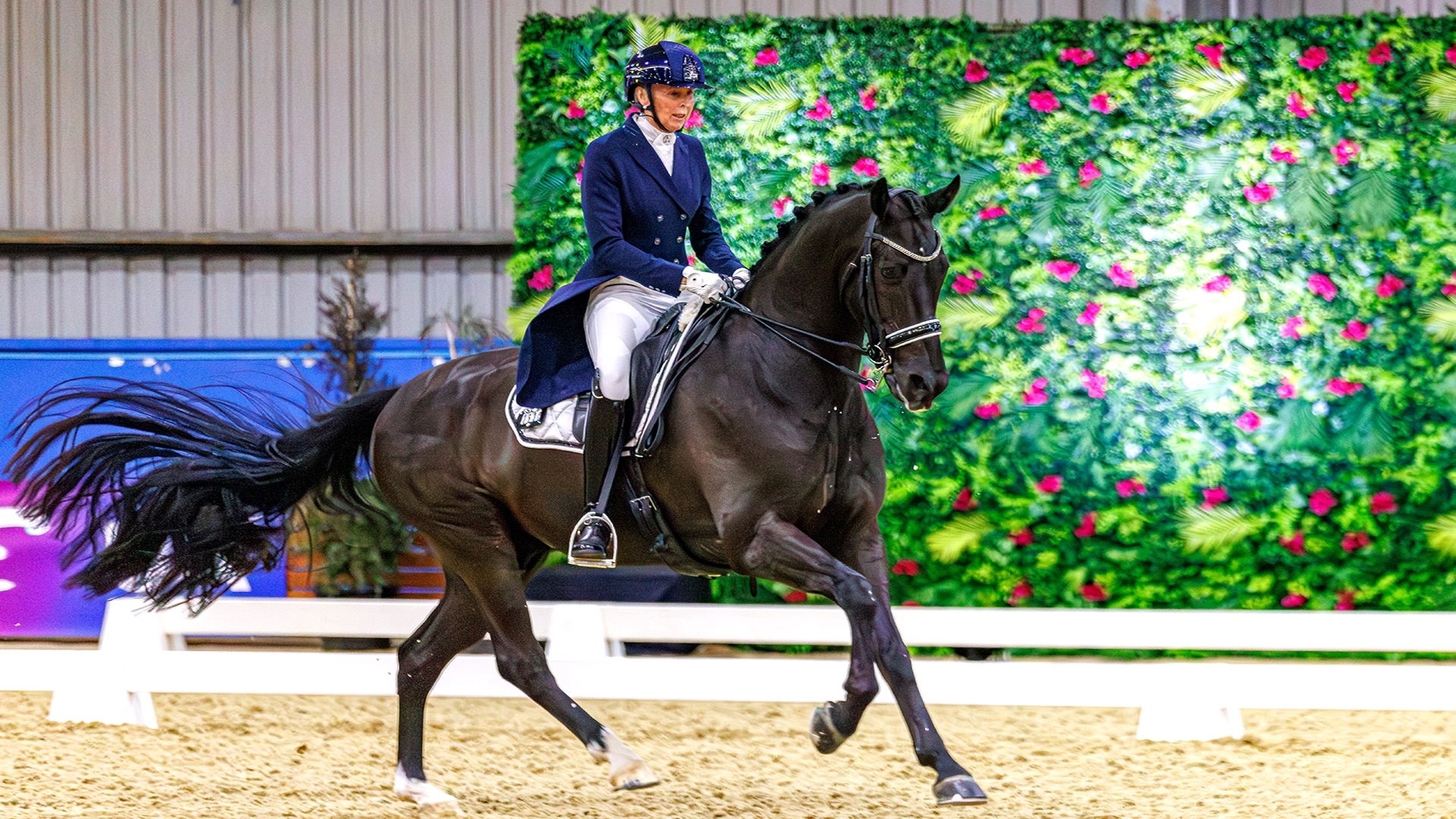
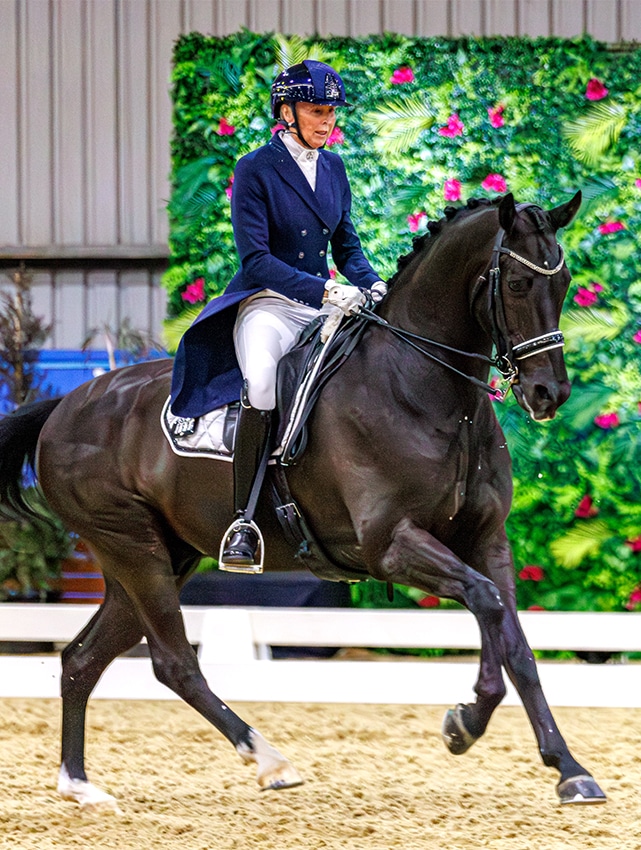
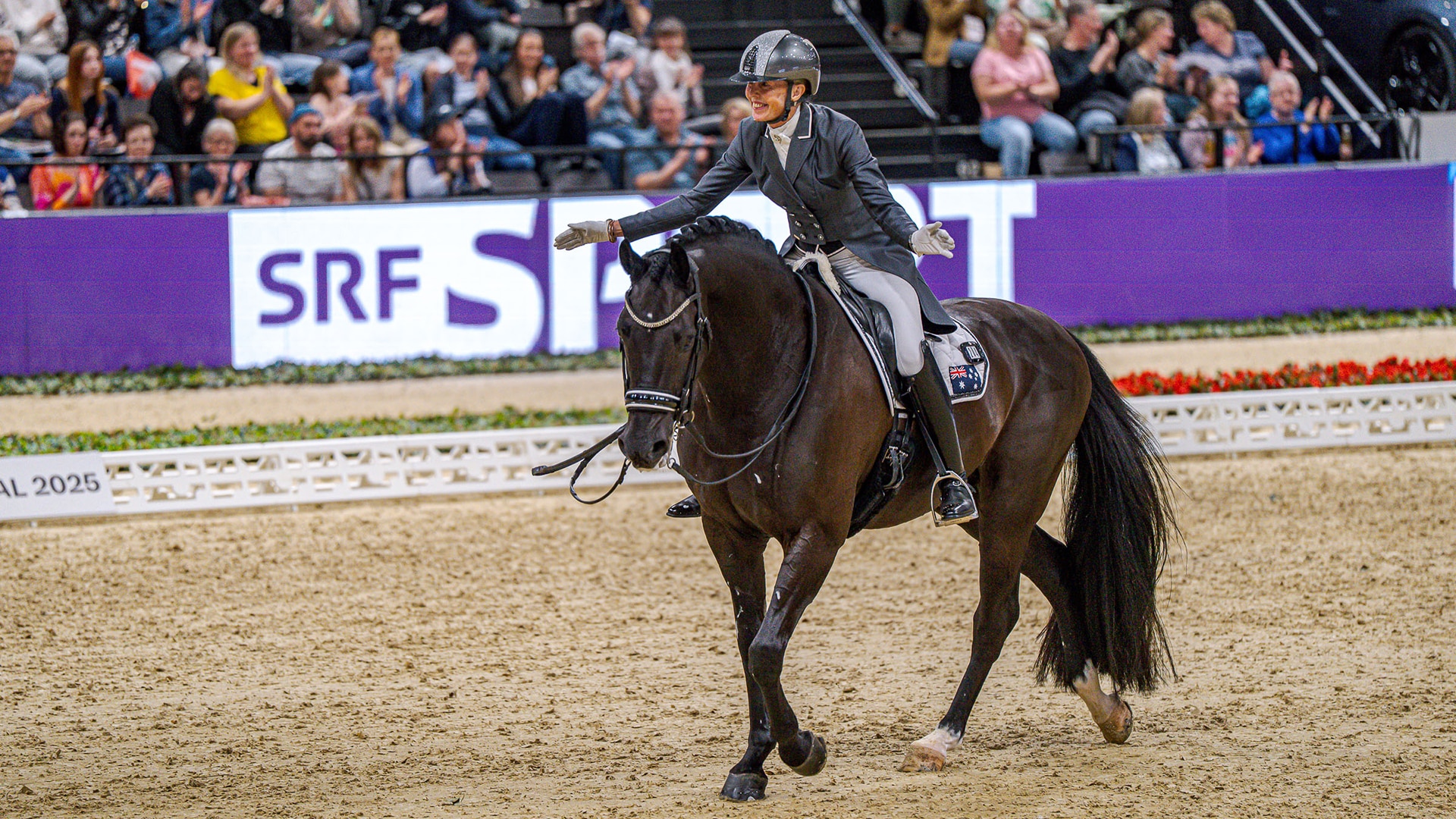
Mary Hanna and Ivanhoe at the FEI Dressage World Cup Pacific League Final in December, 2025. Image by One Eyed Frog Photography.


At an age when many riders have long since stepped away from elite sport, Mary Hanna is not only still competing – she is evolving. Training new horses through to Grand Prix, mentoring the next generation, and preparing for yet another European campaign, Mary remains one of Australian’s most enduring and inspiring dressage figures.
Six Olympic Games, six FEI World Equestrian Games/World Championships and six World Cup Finals, and decades at the top of the sport have shaped Mary Hanna’s career, but if there is one thing that has not changed, it is her curiosity, “For me now, success is really about the training,” she says. “I’m enjoying developing horses, building partnerships, and doing the work properly.”
That mindset continues to drive her daily life – and future ambitions.
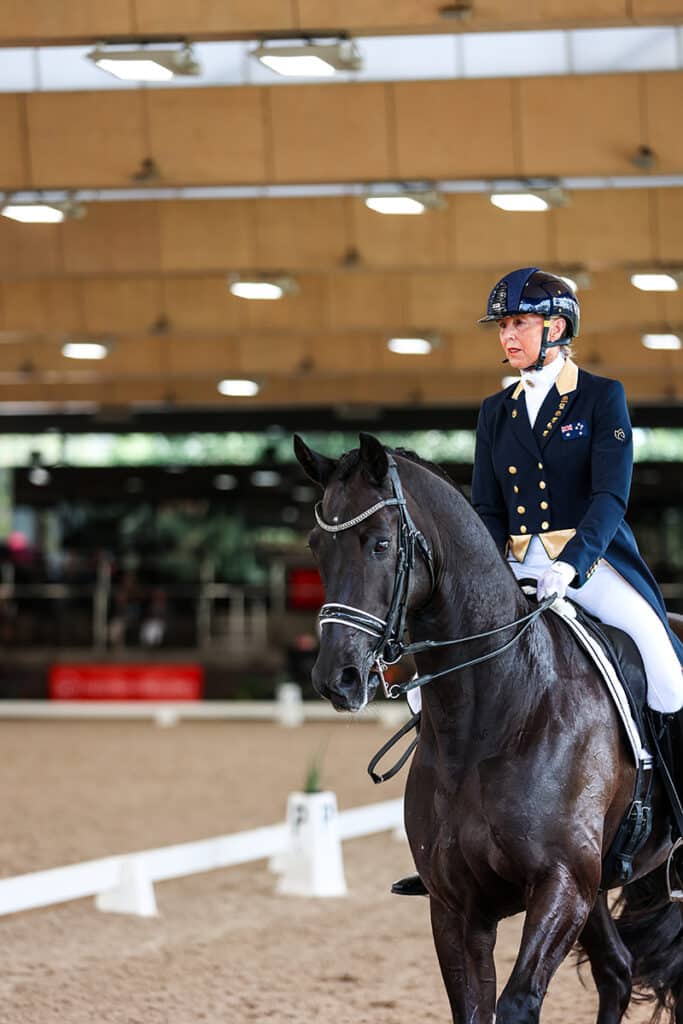
Mary Hanna and Ivanhoe at Dressage by the Sea, February 2026. Image by Ashley Grant – The Blachat.
“For me now, success is
really about the training.”
A STABLE BUILT ON BALANCE AND POTENTIAL
At home, Mary’s current string reflects both experience and promise. At the top sits Ivanhoe, her confirmed Grand Prix partner and a horse she describes as “always on your side.”
“He just does what you want to the best of his ability,” she says. “He’s incredibly reliable. In big atmospheres, he actually keeps me calm.”
That quality was on full display at the FEI World Cup Final in Basel last year, where Ivanhoe handled the intensity of the arena with quiet confidence. “It’s only special horses that cope with that atmosphere,” Mary explains. “He did it like a pro.”
Alongside Ivanhoe is a new addition, Golia Di Fonteabeti, a horse Mary purchased from her long-time trainer and Olympian for Sweden, Patrik Kittel, during a European training stint.
“He was described to me as ‘Mary-sized’,” she laughs. “And that turned out to be exactly right.”
Previously competed in young horse classes, Golia is now stepping into more advanced work, with his first Prix St Georges start on the horizon. While still gaining confidence – “he can be a little spooky” – Mary is impressed by his forward-thinking, work ethic, and natural talent.
“He’s not lazy. The training is sensible, and I think he’s got a really bright future.”
Completing the trio is a striking six-year-old Andalusian stallion known at home as Jeremy (competition name Elite Del Jarma) a horse Mary rides for enjoyment as much as ambition.
“He’s my fun horse,” she says. “Full of character, a big flowing mane, and three very good paces – especially for an Andalusian.”
Jeremy is already showing natural aptitude for passage and flying changes, and while Mary is realistic about the long road ahead, her goal is clear. “My aim is to train him to Grand Prix,” she says simply. “Why not?”
Fauntleroy, who Mary did have some success with, has now returned to Patrik’s to be sold. “He’s a beautiful horse, but he takes quite a lot of energy to ride. I don’t have the capacity for four horses, and I was spoilt for choice,” she says. “I’ll be sad to see him go.”

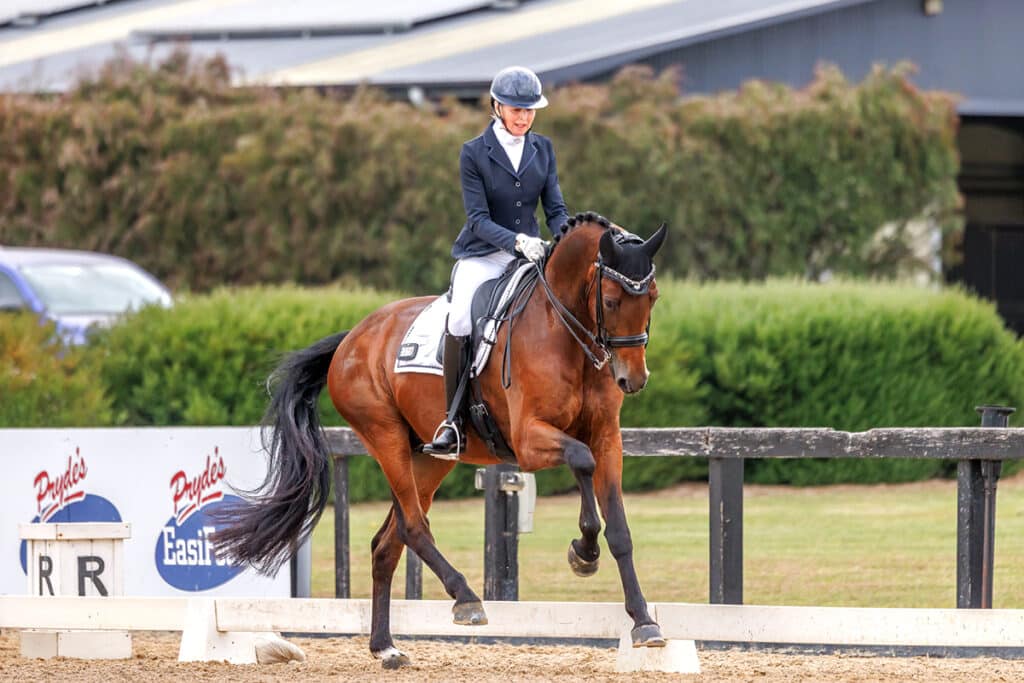
Mary Hanna and Golia Di Fonteabeti competing at Boneo Park at Medium level. Image by One Eyed Frog Photography.
EUROPE CALLING – AGAIN
Mary plans to return to Europe in June for a three-month training block with Patrik, taking both Ivanhoe and Golia with her. The goal is development rather than expectation.
“I want to get out of the Australian winter, do some really good training, and see where things sit,” she explains. “If the World Championships happens, that’s a bonus. I’m happy just doing the work,” she says of possible Australian team selection for the 2026 FEI World Championships in Aachen, Germany.
For Mary, staying connected to Europe is no longer optional – it’s essential.
“The gap between Australia and Europe has grown; the level is accelerating over there,” she says candidly, adding that in order to keep up she feels it’s important to remain connected with the international sport.
The awareness has shaped not only her competition planning, but also her coaching philosophy.
REDEFINING SUCCESS
With decades of elite competition behind her, Mary’s definition of success has shifted. Medals and rankings matter, but they are no longer the sole focus.
“I really enjoy developing horses towards Grand Prix,” she says. “And I love teaching riders who are heading that way too.”
Among them is her longtime manager and student Tori Weir, who is now competing multiple horses at Grand Prix level. Mary beams when she speaks about her progress: “She’s riding two Grand Prix horses now, and another coming through,” she says. “It’s incredibly rewarding.”
The same pride extends to the broader Australian scene, where Mary believes depth is building.
“We’re seeing consistency now in the Under 25s and Young Riders,” she says. “There are some very impressive combinations coming through, a standout being my student, Jess Dertell.”
Among other horses, Jess is currently competing Kilimanjaro at Grand Prix level where she’s competing in CDI Under 25 and CDI3* classes to date with success.
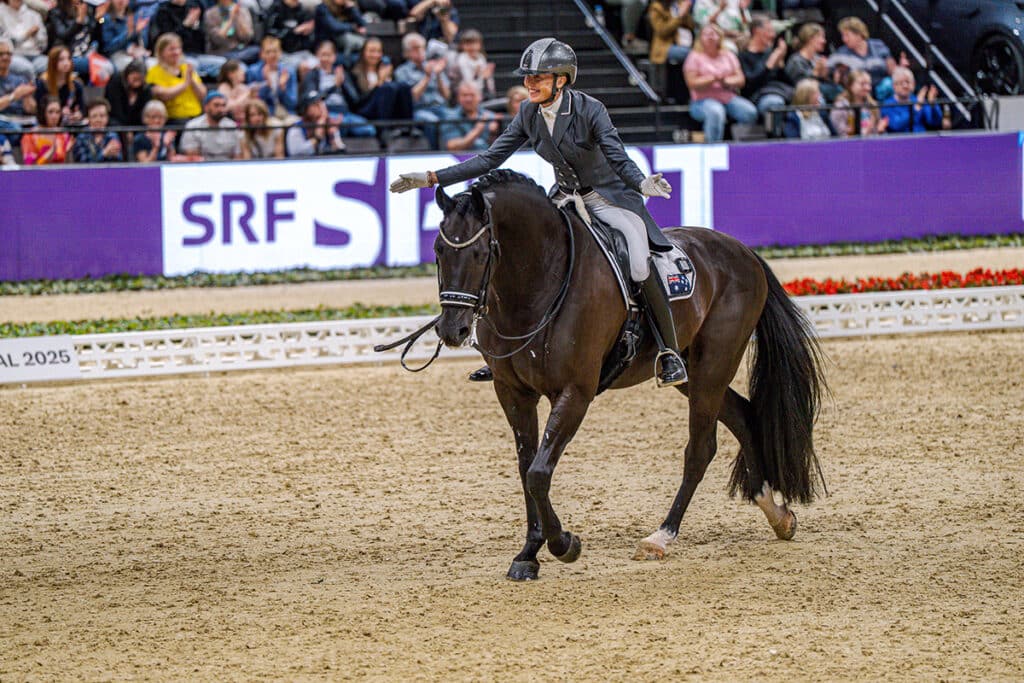
Mary Hanna and Ivanhoe at the FEI World Cup Final in April, 2025. Image by Digishots.
DRESSAGE THEN AND NOW
Having witnessed dressage evolve over half a century, Mary speaks thoughtfully about the sport’s changing values.
“One of the most positive changes is the emphasis on empathy,” she reflects. “Being fair to the horse, thinking about their body, their longevity – that’s a good thing.”
However, Mary is troubled by the double-edged sword that is social media. “Social media is amazing because we can watch tests from all over the world,” she says. “But it’s also created a culture of cruelty at times.”
As a high-profile rider, she has weathered her share of criticism. Her approach now is simple.
“I ignore it,” she says. “I think I’m pretty thick-skinned. It’s not something you can spend a lot of time on. You have to let it pass over you; at the end of the day if you know you’re doing the right thing by your horse, you can’t let that noise in.”
PERFORMING UNDER PRESSURE
If pressure has ever intimidated Mary, it hasn’t shown in the arena. In fact, she believes it brings out her best. “The more pressure I’m under, the better I ride,” she admits. “I thrive on it.”
Her competition routine is deliberately quiet and inward-focused. On show days, she keeps to herself, mentally rehearsing each movement and blocking out distractions. “I don’t want noise,” she says. “I want calm, focus, and clarity.”
That ability to ride on the biggest stages has defined some of her most memorable performances.
“My first Olympics [1996] when I rode Mosaic, he gave me the most sensational feeling in the Grand Prix, the best I’ve ever had,” she smiles. “He also thrived under pressure, the bigger the competition – the better he went. He was only a little horse, just under 16 hands, but when he went into the arena he felt like he was 17 hands. It was amazing; he just knew it was important.”
“The other wonderful ride I had was at Normandy in 2014 at the World Equestrian Games with Sancette. He was also a great horse on a big occasion,” she shares.
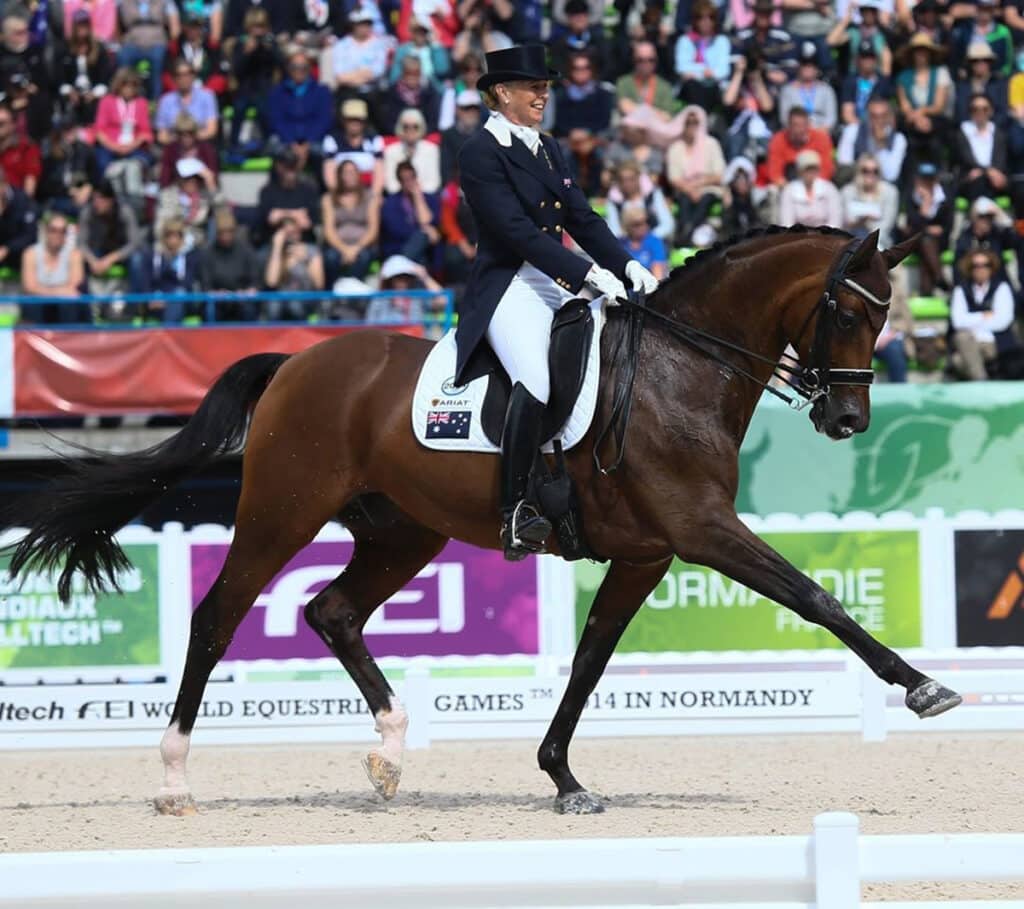
Mary Hanna and Sancette at the 2014 WEG in Normandy.
“I remember it was a big stadium and quite a difficult arena to ride in, very noisy and echoey. You were very, very enclosed, and it was packed. It was a huge crowd, and a lot of Australians there. I rode him and he was just with me. He did a wonderful test to get over 70%. What was so uplifting was we had all the Australians there, cheering and waving their flags. It was a special feeling to have that support from home on the other side of the world.”
LOOKING FORWARD – ALWAYS
Asking whether she might aim for the 2028 Olympic Games in Los Angeles with Golia, Mary laughs – but doesn’t dismiss the idea.
“It’s a long way out,” she says. “But you’ve got to have something to aim for.”
That philosophy has carried her through highs, setbacks, reinvention, and resilience.
“I never imagined I’d still be riding at this level at this age,” she reflects. “Sometimes I even surprise myself.”
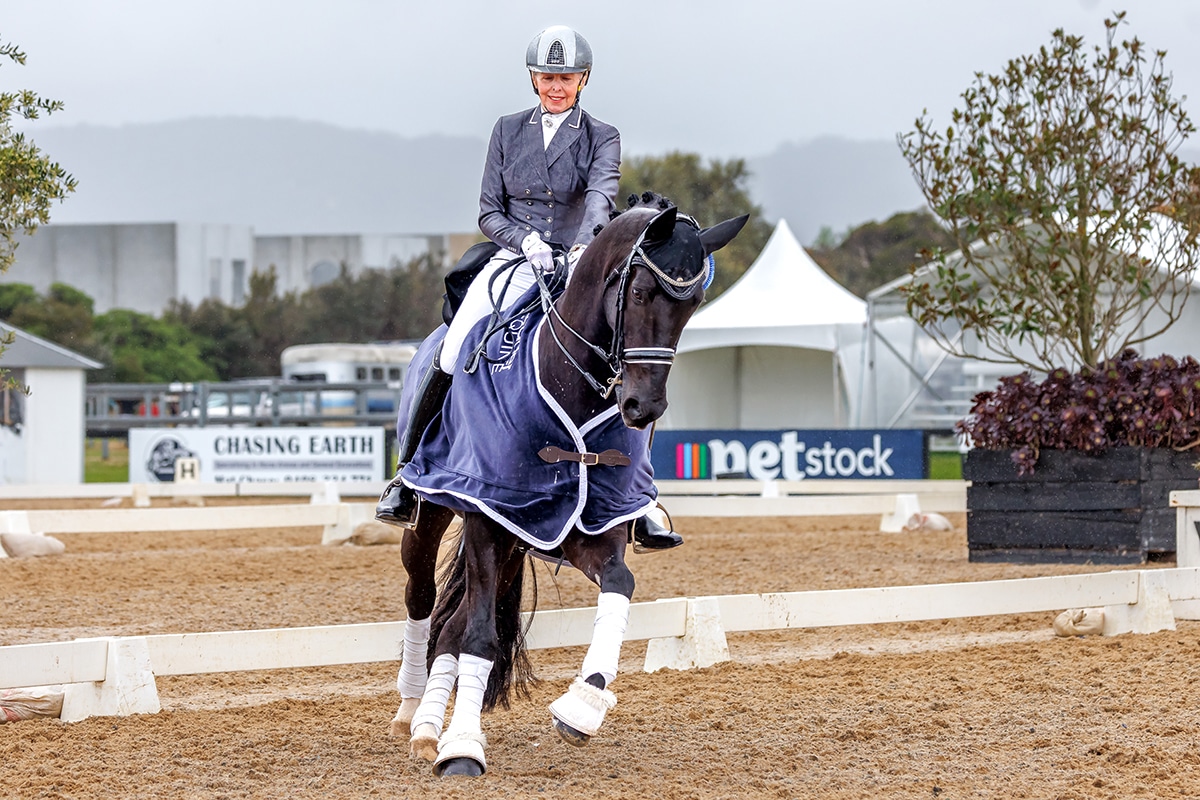
Mary Hanna and Ivanhoe competing at Boneo Park. Image by One Eyed Frog Photography.
There may be stiffer mornings now, and a little more care required, but once she’s in the saddle, nothing changes. “You get on the horse,” she says. “And you get on with it.”
Mary stands as a reminder that mastery is built over time – and that evolution never stops.
Still training, still learning, still dreaming, she continues to shape Australian dressage not just through her results, but through her example. As she prepares to once again head to Europe, chase improvement, and develop the next generation – horse and human alike – one thing is clear: Mary Hanna is not finished yet. EQ
Related articles
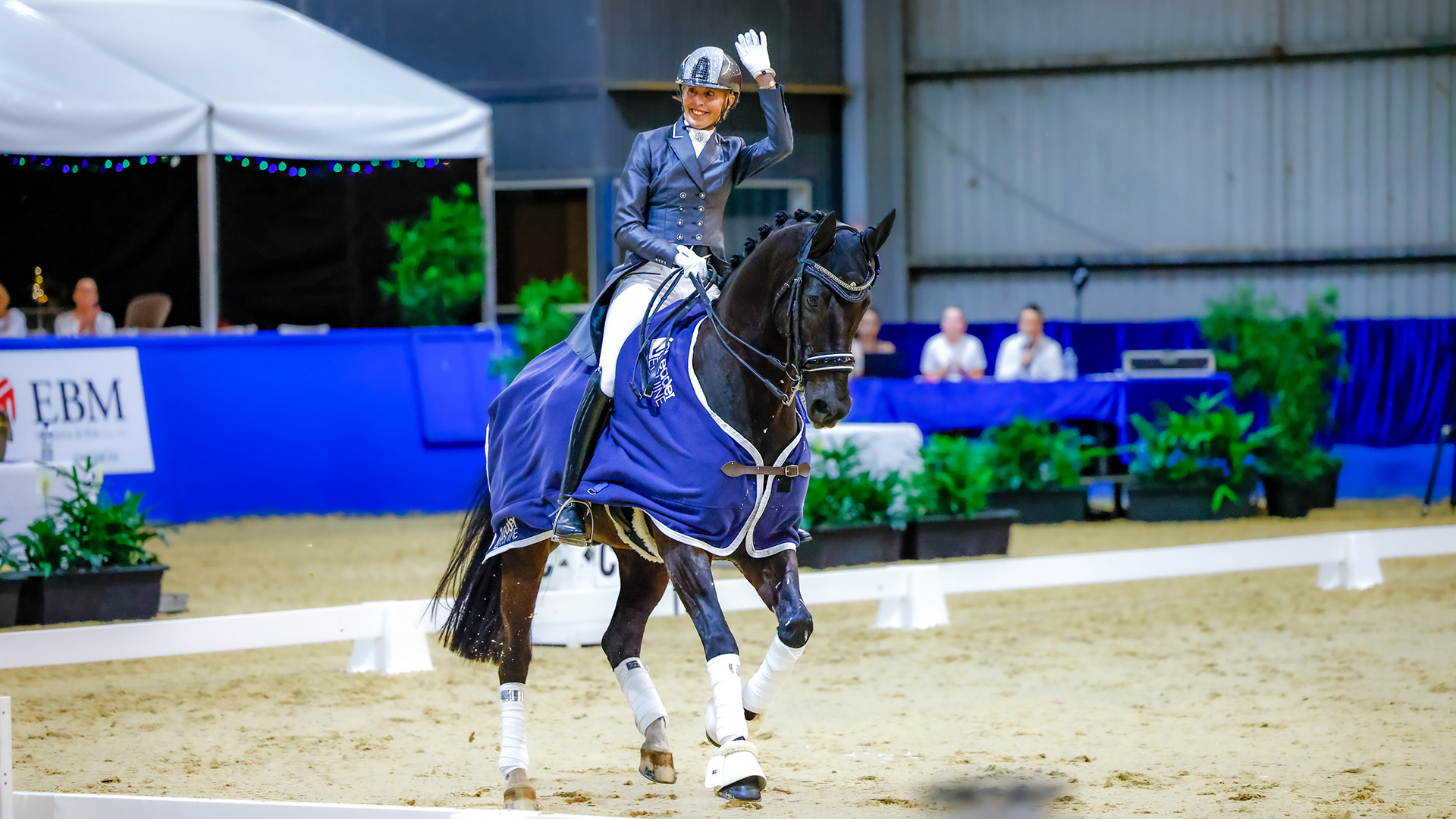
Mary Hanna has represented Australia at six Olympic Games, six FEI World Equestrian Games/World Championships, and five World Cup finals – soon to be six. Renowned for her dogged determination and persistence, the words “quit” and “give up” are not part of Mary’s vocabulary.
Age and experience can bring deeper insight into the art of dressage. The sport has evolved and now many of us are training for connection, not competition — finding joy in partnership over podiums.