

Another thrilling FEI Jumping World Cup season has played out across six continents, with 12 Leagues producing standout performances, shifting leaderboards and hard-earned success stories. While not every campaign centred on the race for a ticket to the Longines FEI Jumping World Cup Final in Fort Worth (USA), finishing on top of a League remains an accomplishment worth celebrating.
By the time the final points had been awarded and the League winners crowned, 759 athletes from 70 countries had taken part worldwide, with 515 collecting points along the way.
Southern style
The series got underway in the Southern Hemisphere, and in the Land Down Under it did not take long for the spark to catch. Gemma Creighton and the 15-year-old gelding Dada Des Brimbelles Z burst out of the blocks with back-to-back victories at Shepparton in March and Werribee one week later, setting the early pace in the Australian League.
But as the season unfolded, it was Victoria’s Phillip Lever and Billionaire NZPH who came to the fore. Lever built his title charge on consistency, contesting six of the nine qualifiers and finishing in the points every time. A pivotal victory at Bawley Point in September gave him the edge, and when the final standings were confirmed, he topped the 42-athlete leaderboard on 78 points, just one clear of Jamie Winning-Kermond. Billy Raymont, the 2024/2025 FEI Jumping World Cup Australian League champion, finished third on 76 points.
Across the Tasman, the New Zealand League drew 13 athletes over five legs, with only the best four results counting. Small in scale but big on excitement, it quickly developed into a duel between Julie Davey and Sophie Scott for the single ticket to Texas (USA).
Davey and the 12-year-old mare LT Holst Freda held their nerve throughout the three-month series and, despite Scott and Normandy GHP producing a stellar performance to win the final at Takapoto in January, Davey had just enough in hand to secure a second consecutive FEI Jumping World Cup New Zealand League title on 87 points, with Scott runner-up on 78.
Female athletes were a defining force across the early Leagues, and South Africa proved no exception. There, 39 starters contested a six-leg series from May to October, visiting Midrand, Shongweni, Polokwane, Plettenberg Bay, Mooi River and Kromdraai. The title went to 23-year-old Amy Chelsea Michau, who produced a breakthrough season with the 15-year-old Zirocco Blue VDL gelding Go To Blue. Victories at Polokwane, Plettenberg Bay and Kromdraai propelled her to the top of the League on 70 points, well clear of Chatan Hendriks on 64 and Dominey Alexander on 59.
Small but mighty
In South East Asia, Indonesia’s Raymen Kaunang came out on top across a three-leg run contested by nine athletes from the host nation, all of whom collected points, making it the smallest of the 12 Leagues. With the 12-year-old KWPN mare Juliette, Kaunang built his winning total with runner-up results in both Jakarta and Limo to edge Dirga Wira Ramadan Sahputra and Jendry Palandeng, who finished second and third respectively.
The Eurasian League traced a wide geographical arc through Uzbekistan, Kazakhstan, Kyrgyzstan and Georgia across six legs, with 17 athletes competing from April to September. It was across the opening four rounds that the League began to take shape, as Bekzod Kurbanov and Khurshidbek Alimdjanov of Uzbekistan, along with Rinat Galimov of Kyrgyzstan, emerged as the leading contenders, each with a victory to their name. In the end, it was Kurbanov, riding the 14-year-old Belgian Warmblood gelding Matts V.G. throughout the series, who came out on top ahead of Galimov in second and Alimdjanov in third.
Kenki Sato underlined his status as one of the Japan League’s most accomplished athletes by claiming the 2025/2026 title aboard the 16-year-old mare Shanaclough Contadora, who he partnered throughout the season. A double Asian Games gold medallist in Eventing and former League winner in 2022/2023, Sato set the tone early with victories in the opening two legs at Osaka and Kakegawa. When the seven qualifiers concluded, he and Atsushi Katayama were tied on 18 points, with the title decided on countback in Sato’s favour after recording two wins to Katayama’s one. Korea’s Hansu Kang, the only non-Japanese athlete among the 18 competitors, completed the top three on 15 points.
China’s return to the League brought a different kind of pressure. With just three qualifiers staged in Beijing, Wuhan Business University and Chengdu, and only two results counting towards the final standings, there was no margin for error among the 42 athletes who took part. Zhixiang Jiang made the most of that format, combining runner-up finishes in Beijing and Chengdu aboard the 17-year-old mare Jacinthe Van Dorperheide. Compatriot Muladeli Muladeli took second, while Yi-Tsung Chen of Chinese Taipei followed in third.
Sub-leagues
The Arab League’s two sub-leagues produced deserving champions in contrasting circumstances. In North Africa, all 18 athletes collected points across a three-leg series in Morocco, and El Ghali Boukaa put together the strongest overall campaign on home soil. Riding the 16-year-old Selle Français mare A Kyss, he followed a sixth-place finish in the second leg at Rabat with a runner-up result in the third at El Jadida to seal top spot on 35 points, just ahead of compatriot Abdelkebir Ouaddar and Egypt’s Zain Shady Samir, both on 32 points.
The Middle East sub-league was a hotly contested division. Fifty-one athletes lined out across eight legs in Saudi Arabia, the UAE, Kuwait and Qatar, and Abdullah Alsharbatly of Saudi Arabia emerged on top with 65 points, his ability to rotate effectively between four horses giving him the competitive advantage. He opened with a runner-up finish aboard Alamo to collect crossover points in Rabat, then campaigned Boeckmanns Lord Pezi Junior in Riyadh, delivered two wins with Skorphults Baloutendro in Kuwait, and rounded out his season with Valentino in Qatar. Even so, the standings remained tight throughout, with Abdulrahman Alrajhi close behind in second on 63 points, level with Belgium’s Abdul Saïd in third.
Central Europe was also divided into two sub-leagues, North and South, which together attracted 139 athletes before culminating in the League Final in Krakow (POL) earlier this month. Carrying forward their best five results, 17 finalists made it through to the decider, with just four coming from the Southern division and the remaining 13 from the North. Türkiye’s Necmi Eren topped the Southern sub-league standings, while Natalie Kovarova of the Czech Republic led the way in the North, but the balance shifted when it mattered most.
In Krakow, 24-year-old Hungarian athlete Péter Szuhai and the 12-year-old Oldenburg mare Corbluecenta stayed firmly in the mix across the three final competitions, surging to the title on 103.5 points after a season that had already seen him finish second in the Southern sub-league. Latvia’s Kristaps Neretnieks finished second on 96 points, with Eren third on 79.5.
The Americas
With 60 athletes contesting five legs between April and November, the South American South League developed into a tightly fought contest shaped largely on Brazilian soil, with four qualifiers staged there and the fifth in Argentina.
Stephan de Freitas Barcha, Brazil’s individual gold medallist at the Santiago 2023 Pan American Games, built his winning tally aboard Chantily Jmen, Chevaux Goldfinger and Castilio C Jmen I to finish on 52 points. His best result was a runner-up finish in the season opener at Curitiba, but it was his ability to keep adding points that saw him finish ahead of fellow Brazilian Guilherme Dutra Foroni, who took second on 47, while Brazil-based South African Charlie Bays was third on 37.
The North American League was the second largest of the FEI Jumping World Cup™ 2025/2026 series, drawing 99 athletes across seven legs from September through to February. With qualifiers spread across the United States, Canada and Mexico, it pitched emerging contenders against some of the sport’s biggest names.
Ireland’s Conor Swail topped the overall standings and looked untouchable for much of the campaign, collecting points in each of the first five qualifiers he contested to finish on 51. Hailing from outside North America, he qualified for the April Final as an extra athlete, leaving Kent Farrington as the highest-placed home athlete on 42 points.
The final flourish, however, belonged to 21-year-old Mimi Gochman, who lit up the Ocala (USA) finale with a sensational victory aboard the 11-year-old gelding Iron Maiden. It was her first win at the highest level of the sport and, having partnered the horse for less than a year, a career-defining result. More importantly, it punched her ticket to Fort Worth and secured her place at her first senior championship as she closed the season in third on 37 points, just behind Farrington.
Last League standing
The Western European League was the last to close its doors, only wrapping up in Helsinki (FIN) on 1 March. The largest and most competitive circuit of the season drew 212 athletes across 13 legs, with only the best seven results counting and 18 coveted tickets to the Final at stake.
Dutch athlete Willem Greve emerged from it with a season to savour. Three victories in a Western European campaign represented a considerable return by any measure, and Greve used them to move clear at the top of the standings on 81 points. He struck twice with Pretty Woman van’t Paradijs N.O.P. in Stuttgart and A Coruña (ESP), before adding a third with Grandorado TN N.O.P. in Gothenburg (SWE), a display of exceptional form and enviable depth.
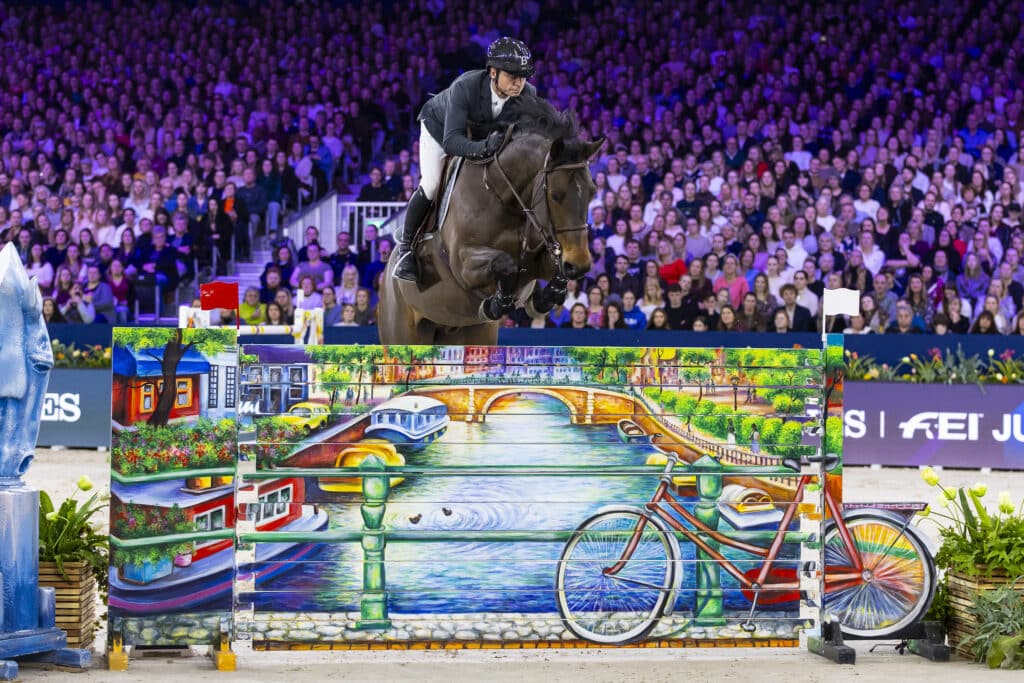
Behind him, France’s Julien Epaillard produced a superb season despite having no need to chase qualification as defending champion. The Frenchman contested nine legs and collected points in seven, including victory in Amsterdam (NED) aboard the 13-year-old homebred gelding Donatello d’Auge, to finish second on 69 points. Germany’s Daniel Deusser took third on 66.
So hold on to your hats, because the road now leads to Fort Worth, where the 46th Longines FEI Jumping World Cup Final will take centre stage next month. Invitations have been sent to the qualified athletes, and the final line-up will be announced shortly. After 12 Leagues, 70 nations and a season rich in drama, depth and distinction, the sport’s next great showdown awaits.
Source: FEI press release by Kirsty Pasto