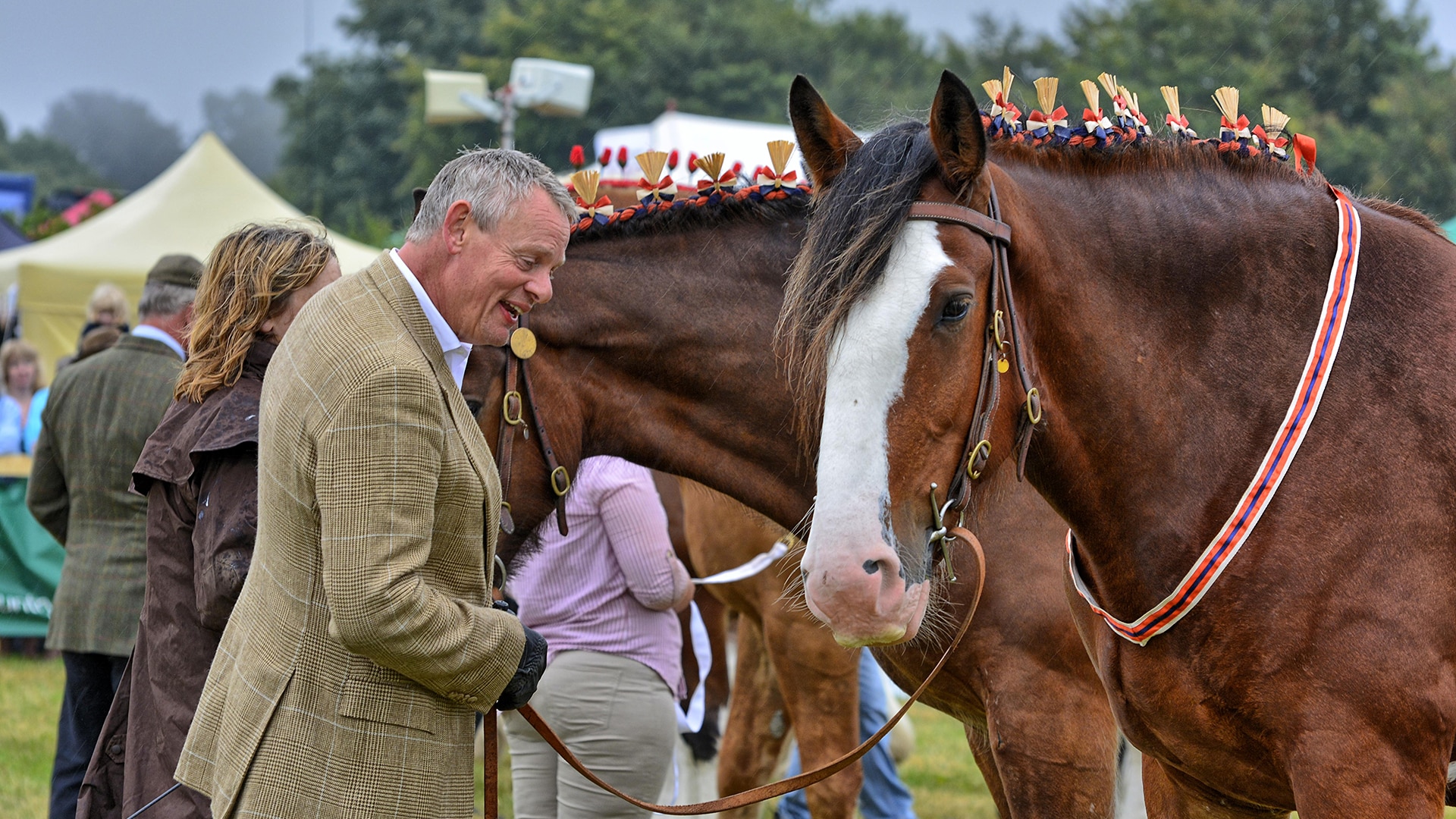
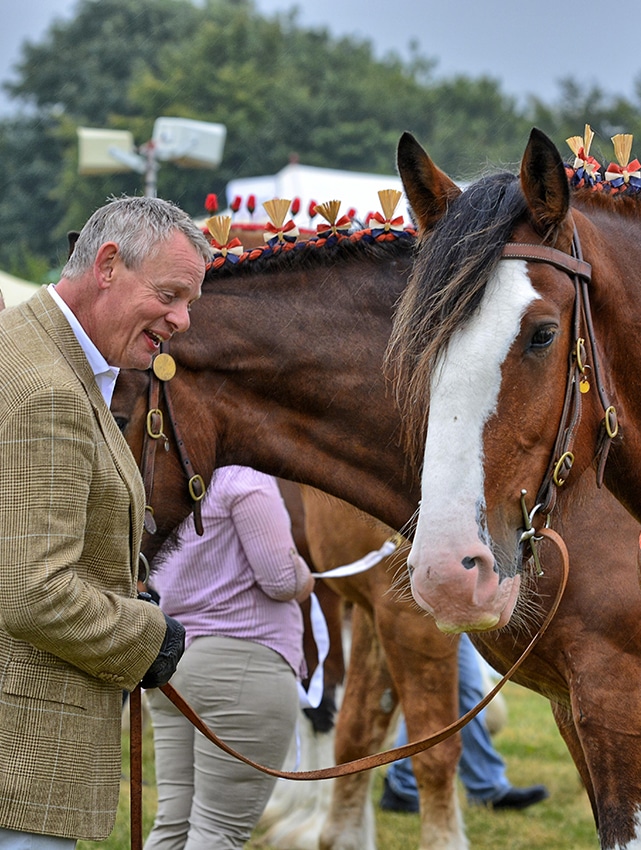
Martin Clunes is a fan of horses – especially the draught breeds. Image by Philip Gough.


Best known for his role as the grouchy GP in the Doc Martin TV series, Martin Clunes loves horses and is head of the British Horse Society and a member of the British Carriage Driving Society. It was natural he would make documentaries about working horses.
‘HEAVY HORSEPOWER’ – 2013
Martin Clunes documentary, produced by Buffalo Pictures
From the time he was 19 Martin Clunes has been an actor working in theatre, film and television. Many will remember Men Behaving Badly, his starring and supporting roles in scores of shows, as the lead in Manhunt and, of course, as the unsmiling titular character in Doc Martin – a GP who suffers from haemophobia in a Cornish seaside town.
Before working on this long-running series, he had met Philippa Braithwaite, a keen horsewoman, who was to become Doc Martin’s producer. They married in 1997. Her love for country life ignited Clunes’ interest and they moved from London to Dorset. After living in an old vicarage, they bought a nearby farmhouse on 130 acres where they live with their cattle, sheep, dogs, cats and horses.
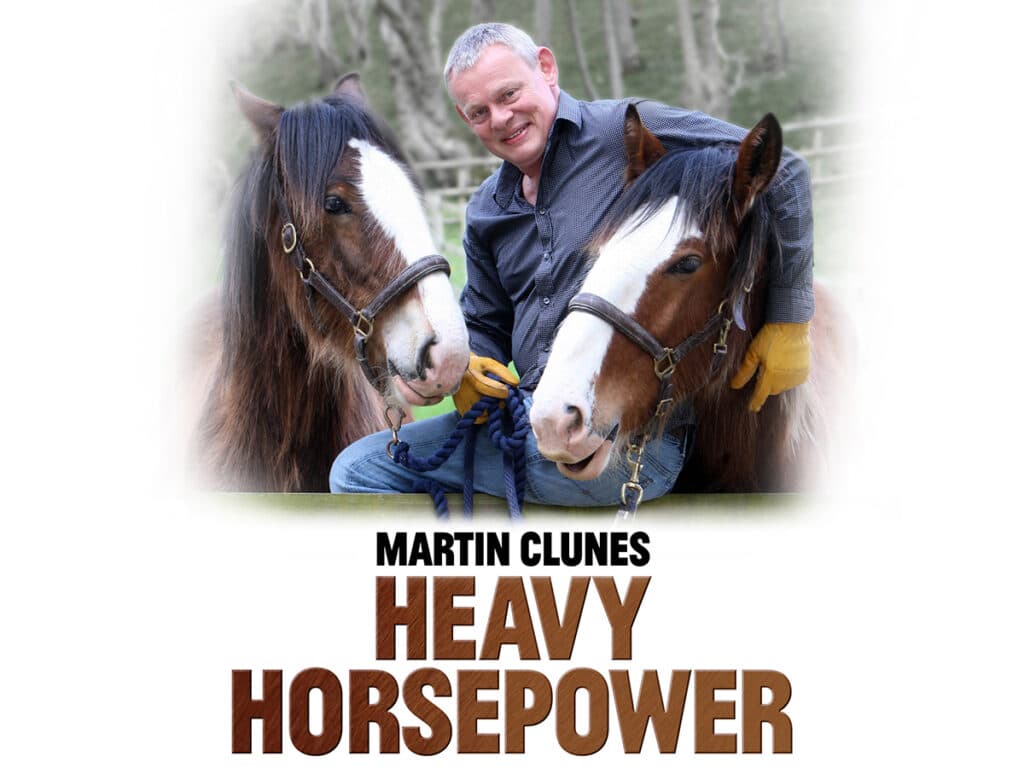
‘Heavy Horsepower’ is a 2013 documentary featuring Martin Clunes and produced by Buffalo Pictures. Image supplied.
“At the bottom of the
score sheet the judge
just wrote ‘Wow!’”
When opportunities have arisen, Martin has branched out from screen acting to presenting travel and animal-themed documentaries. Titles include A Man and his Dogs (2008) filmed around the world discovering the centuries-old relationship between dogs and humans; later came Horsepower (2010) and in 2013 Heavy Horsepower, which features his two Clydesdales, Ronnie and Bruce.
Prior to making this series, Martin had become the president of the British Horse Society, a position the affable 64-year-old actor still holds today.
A SURPRISE DRESSAGE TALENT
Martin was chuffed several years ago when Bruce, ridden by a local equestrian, won a dressage competition in Dorset. “He got 72.6% and the next horse closest to him scored 66%,” Martin recalls. “At the bottom of the score sheet the judge just wrote ‘Wow!’”
Incidentally, Ronnie and Bruce were instrumental in getting Clunes out of a spot of bother after the documentary was produced. After incurring a raft of speeding fines, he lost his licence for six months, so he hitched the two to a cart which they’d been taught to do in the documentary.
“After getting used to travelling so slowly I began to like this form of transportation and enjoyed staring at the horses’ bums as they plodded along,” he says.

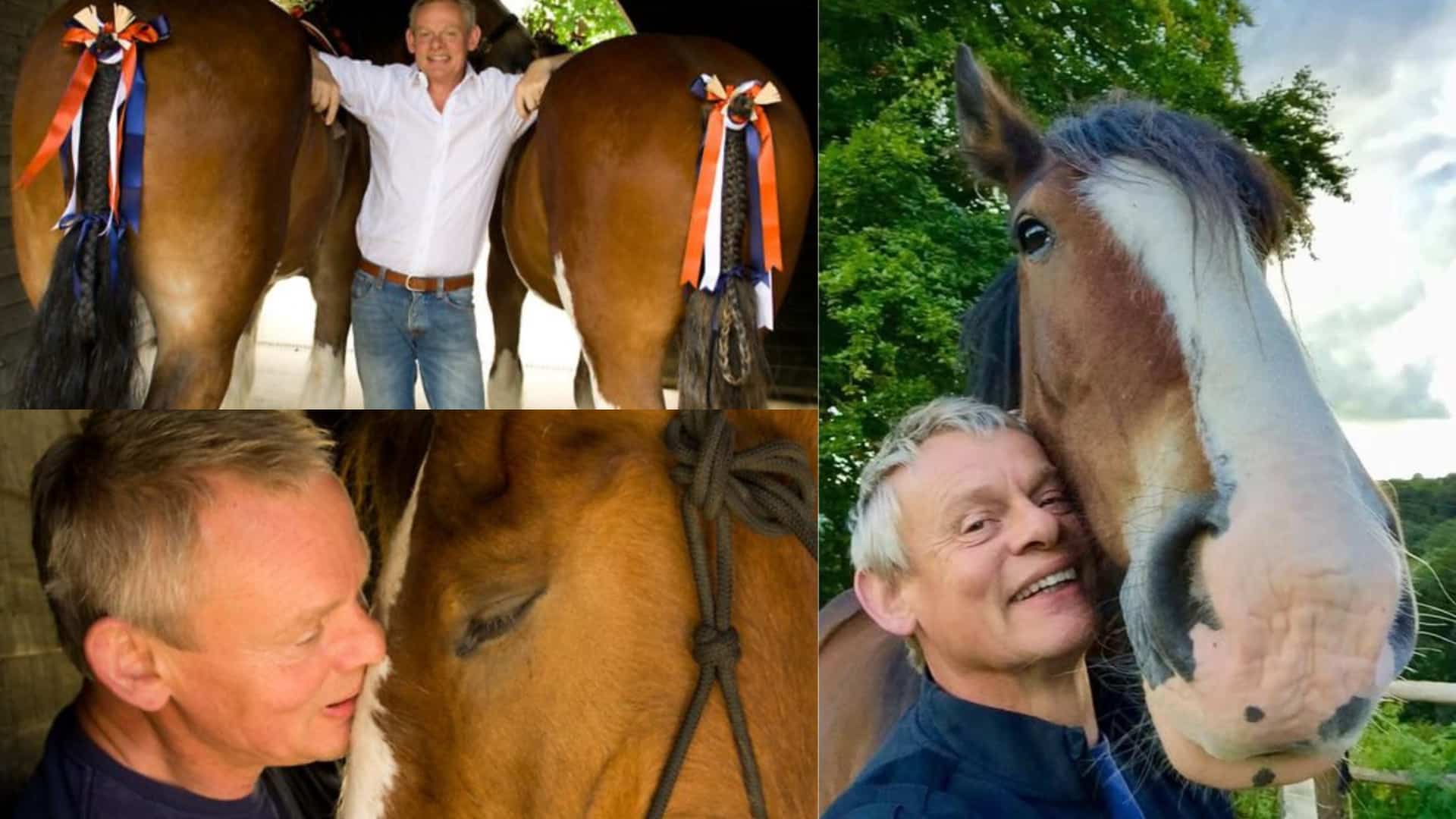
Martin Clunes with Ronnie and Bruce. Images supplied.
TRIVIA:
In the 2018 mini-series Vanity Fair, Clunes was delighted to be cast as Sir Pitt Crowley. “Page 1 of the script said that Pitt drives his own carriage, and I was overjoyed when I read that. I’m a member of the British Carriage Driving Society so I did all my own driving with two black Friesians, which were lovely.”
In Heavy Horsepower, Martin focuses on the significant role of heavy horses in the UK, Europe and the United States, interspersing segments with the training of his young lookalike Clydesdales, which he describes as “lovable but uncontrollable teenagers”. (Bruce is taller with a thinner blaze.)
“If you’d said 10 years ago I’d be driving a seven-and-a-half-ton truck taking my horses to hoof camp, I’d have laughed in your face. But it’s a reality and it’s very exciting,” declares the good-natured actor, who this documentary reveals to be a somewhat naïve childlike owner in awe of many aspects of horsemanship.
On the first day of shooting Ronnie kicked him and Bruce hit him on the head and knocked him down. Then they both pulled and pawed at camera equipment on the ground. Clearly these two were ready for some specialised training, which they received from farmer Robert Sampson, who works with Percherons in Hampshire. “There’s a good niche market for work horses these days,” he notes.
DRIVING THE BUDWEISER WAGON
Clunes visited New Orleans to meet some Budweiser Clydesdales being prepared for a parade; he even drove them through the city streets. He learnt that the original team of six had been given to August Busch Sr who was president of Anheuser-Busch when the 18th Amendment (Prohibition) took effect in 1920. He had publicly opposed the law, considering it a “miserable Prohibition failure”.
His sons, August Jr and Adolphus, had presented him with the team to celebrate the repeal of the act in 1933. The horses were an immediate marketing sensation, symbolising the return to “the good life”. Today the company breeds and owns over 250 Clydesdales – but based on very specific physical and mental criteria, only a few make it to “the hitch”.
TRIVIA:
At midnight on April 7 1933, the Buschs’ Clydesdales delivered a case of the first post-Prohibition beer to the White House as a gift to President Franklin D. Roosevelt. This team was used for celebratory tours and later for deliveries.
In a vineyard in Italy he is introduced to the Comtois, a breed originating from the Jura Mountains between France and Switzerland. Along the vines these draughts are used instead of tractors as their hooves aerate the soil gently, so that unlike heavy machinery they promote water/oxygen absorption and naturally fertilise.
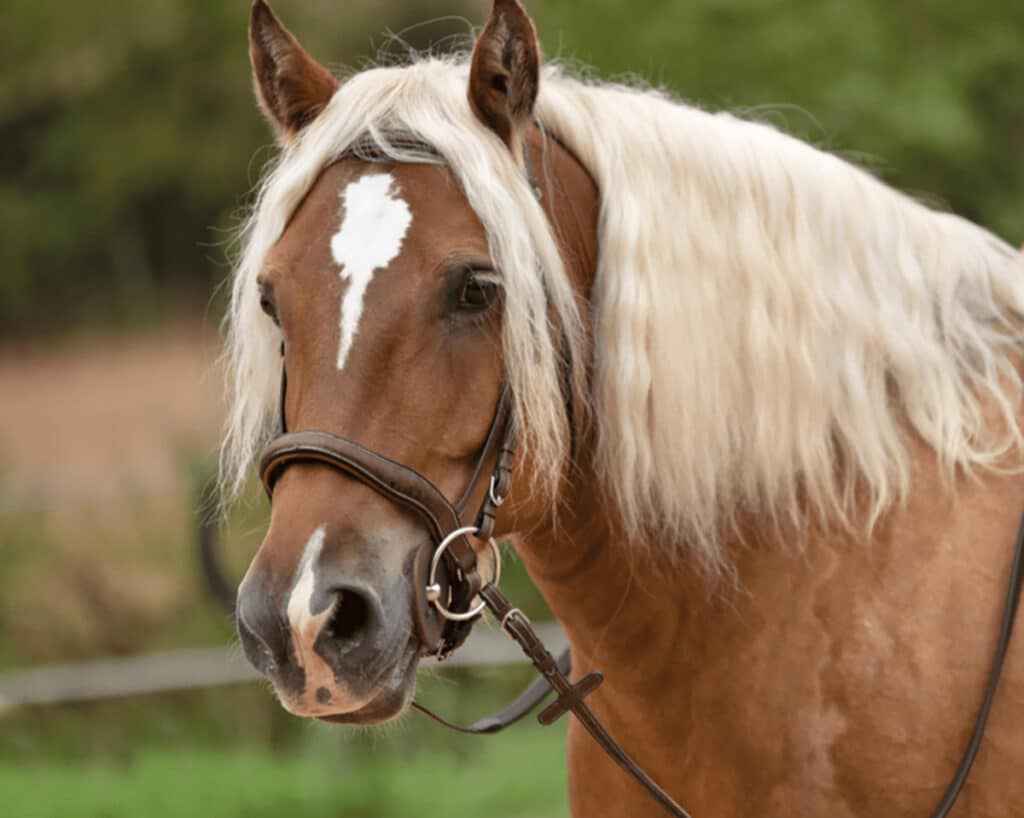
The Comtois, a breed originating from the Jura Mountains between France and Switzerland.
“These draughts are used
instead of tractors as their
hooves aerate the soil gently…”
Calm and serene they are the Rolls Royces of heavy horses. “Better than any tractor,” says their Italian handler who, because they were trained in France, always instructs them in French.
Back in England Clunes catches up with a Czech logging champion whose horses pull out the fallen timber from a forest in Worcestershire. He was impressed with their work – “skilful, surefooted, quieter and more effective than any mechanical power”.
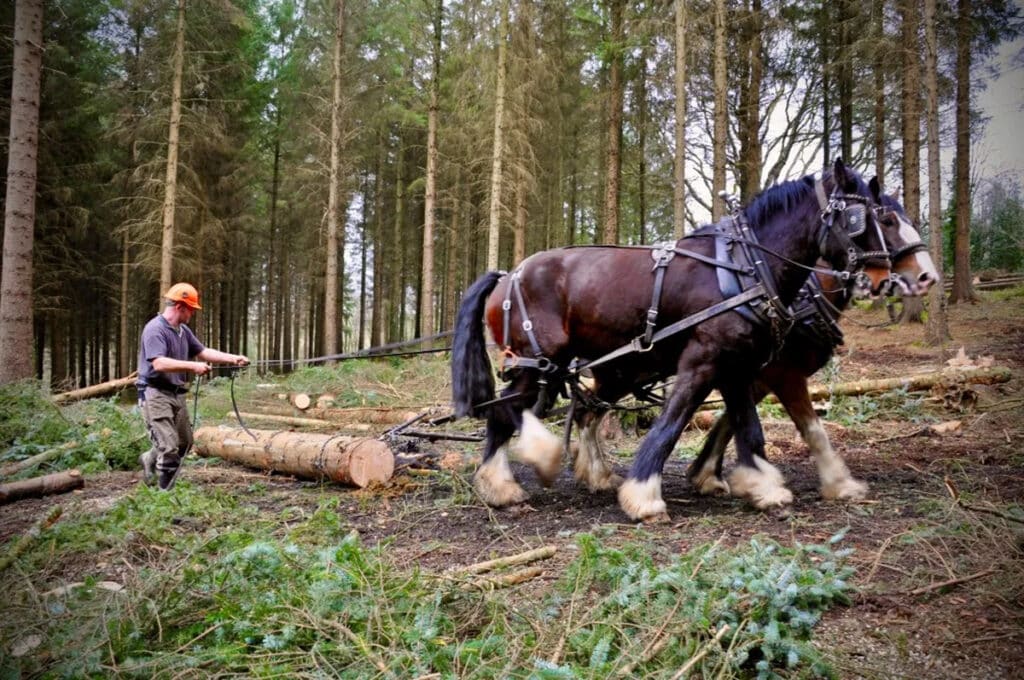
A Czech logging champion utilises horses to pull out the fallen timber from a forest in Worcestershire.
FISHING ON HORSEBACK
The same could be said about the shrimp-catching Belgian draughts, also known as Brabants. In Oostduinkerke, an unpronounceable coastal town in West Flanders, fishermen ride them breast deep into the North Sea while the horses pull funnel-shaped nets held open by two wooden boards. A chain dragged over the sand creates vibrations causing the shrimp, or prawns, to jump into the net. The fishermen then transfer the catch into baskets hanging at the horses’ sides.
With difficulty Clunes mounts one of the Brabants, which he observes was “as wide as it was long and resembled a rhino”. He participates in the fishing and appears to enjoy himself immensely.
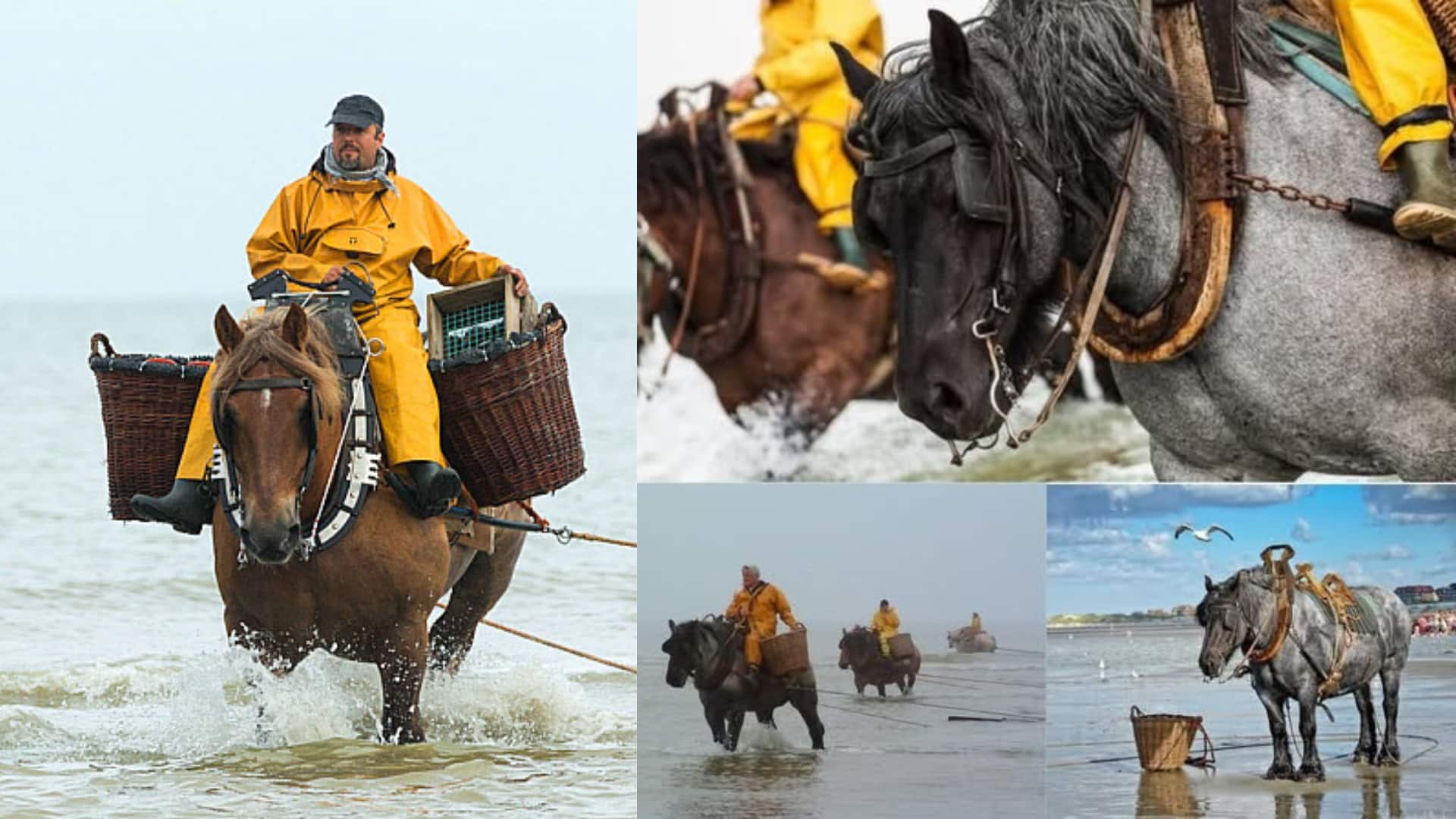
Belgian draughts, also known as Brabants, are used by Belgian fisherman to catch shrimp in the North Sea.
He also takes part in a competition where 12 teams of horses, at the walk, pull rowing boats filled with tons of sand along a beach. He joins the British entry, comprising Suffolk Punches, which end up fourth.
Then it is off to the Household Cavalry to witness the training of its iconic drum horses.
TRIVIA:
Willa Rose, now known as Major Juno, is the first-ever female Shire to serve as a Household Cavalry Drum Horse in the UK, officially named by Queen Camilla in 2023. She’s famous for leading the Trooping the Colour parade carrying the silver kettle drums, and is known for her gentle nature and remarkable quick training.
There is no doubt Martin Clunes relished making this documentary and his love for the animals is infectious. As he says: “There’s something about heavy horses’ stoicism, honesty, size and reliability that just gets to me.”
It can be viewed on DVD and on YouTube.
Next time in ‘Horses & Movies’, The Lone Ranger (2013), starring Johnny Depp and Armie Hammer. EQ
Related articles
Eight-year-old Elyse can’t remember a time when she didn’t love horses. Long before she ever swung a leg over a saddle, she was the little girl who begged her mum to pull the car over whenever they drove past Sun Valley Pony Club. Not for the scenery, not for the quiet roads – but for the pony riding. She would sit in the back seat eyes wide, watching riders go past, imagining one day it might be her.
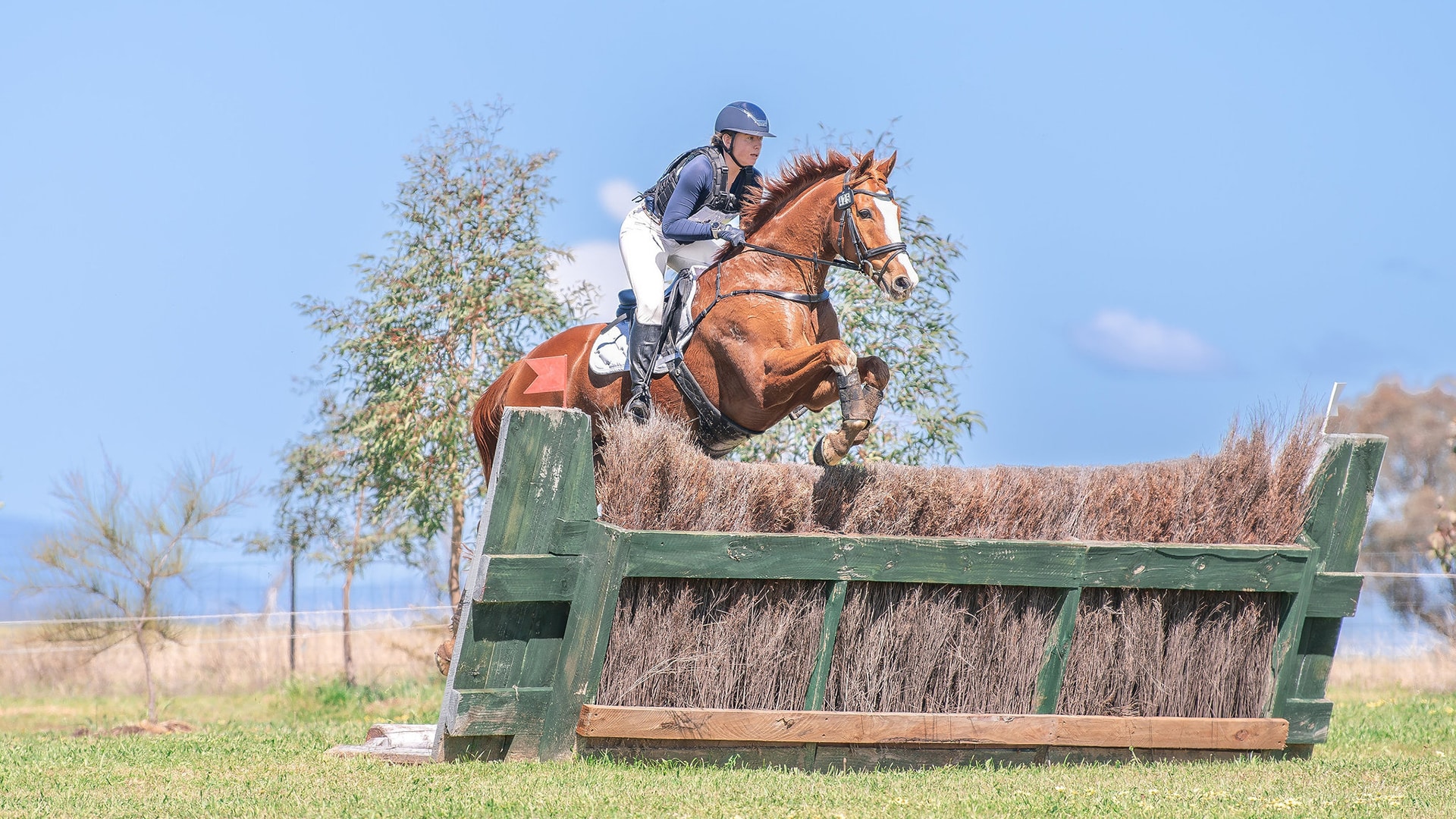
At just 22, Hannah Deegan is rapidly establishing herself as one of Australia’s most exciting young eventing talents. Her double victory at the 2025 Sydney International Three-Day Event, where she claimed the CCI3*L aboard HK Hawthorn and the CCN1* on Zipalon HK, has turned the spotlight firmly onto the hardworking rider whose passion for Thoroughbreds is matched by her dedication to the sport.